Showing posts with label Rocky Mountain Spotted Fever. Show all posts

Tuesday, July 17, 2007

San Mateo County: Population Dynamics of the American Dog Tick and Pacific Coast Tick

Entomology Report June 2007, San Mateo County Mosquito Abatement District

District staff have been monitoring the seasonal population dynamics of the American Dog tick (Dermacentor variabilis) and the Pacific Coast tick (Dermacentor occidentalis) along the coast this year. These ticks are potential vectors of tularemia and Rocky Mountain Spotted Fever in California. Human cases of these diseases appear to have been acquired in San Mateo County during the past 3 years. Cases of tularemia have occurred in children camping south of Pescadero in 2004 and 2006. In 2004, a tick removed from a patient tested positive and in 2006, infection was detected in local ticks collected in the same area.

Adults of these ticks appear during spring and summer months. Because they are not vectors of Lyme disease, they have not been surveyed by District staff as extensively as the Western black-legged tick. The District is now sampling for these ticks on a weekly basis to further characterize their seasonal population trends. This information will be incorporated into public education campaigns that teach people to avoid tick-borne diseases.

Previous related entries:

San Mateo County: Tularemia Detected in Coastal Ticks, September 2006

Wednesday, May 23, 2007

Orange County: Rocky Mountain Spotted Fever Confirmed in County Park

Rocky Mountain Spotted Fever confirmed in County park, Orange County Vector Control District

Rocky Mountain Spotted Fever confirmed in County park. A Pacific Coast Tick, Dermacentor occidentalis that was collected in Aliso and Wood Canyons Wilderness Park tested positive for Rocky Mountain Spotted Fever (RMSF). Orange County Vector Control District (OCVCD) collected the tick on January 29, 2007 as part of an ongoing surveillance program. Samples were submitted to the California Department of Health Services (DHS), although the actual testing was done by The Centers for Disease Control and Prevention (CDC). The District received confirmation on the positive tick from DHS on, March 30, 2007.

Friday, February 16, 2007

San Mateo County: Results of the Evaluation of Trailside Mowing as a Tick Control Method

Entomology Report January 2007, San Mateo County Mosquito Abatement District

This four-week study concluded that the mowing of grass on the sides of public recreation trails in San Mateo County was not an effective control method for Dermacentor ticks. In fact, although the sample size was relatively small, the density of Dermacentor variabilis ticks was found to have increased slightly on sites after they had been mowed. The density of Dermacentor occidentalis was not shown to have any significant relationship to mowing. While they do not transmit Lyme Disease, Dermacentor ticks remain a public health concern, as they are known to vector both Rocky Mountain Spotted Fever and Tularemia, and are very common ticks in San Mateo County.

Previous related entries:

San Mateo County: Effects of Mowing on Summer Tick Populations, June 2006

San Mateo County: Results of the Efficacy of Suspend on Density of Ticks Along a Recreational Trail, January 2007
San Mateo County: Trial Application of Suspend for Control of Ticks, May 2006
San Mateo County: Trial Application of Suspend for Control of Ticks, April 2006

Monday, October 31, 2005

Tick-Borne Disease Surveillance in California, 2004

Vector-Borne Diseases in California, Annual Report 2004, California Department of Health Services, Vector-Borne Disease Section

Human disease surveillance

Lyme disease

Fifty-two cases of Lyme disease were reported to the California Department of Health Services (CDHS) in 2004. Case-patients were residents of 24 counties. Humboldt County reported the most cases (8) and incidence was highest in Trinity County at 23 cases per 100,000 residents. Of 32 cases for whom site of likely exposure was reported, 12 (37.5%) had exposure outside of their county of residence; 7 (22%) of these reported exposure outside California. The most frequently reported location of exposure was Humboldt County (9 cases).

The median age of reported Lyme disease cases was 32 years (range, 3 to 80 years) and 31 (60%) were male. Race was reported as white for 47 (91%) cases, Asian for 3, black for 1, and unknown for 1 case. Erythema migrans (EM) was identified in 23 (44%) cases. Of 22 cases with EM for which date of illness onset was reported, 13 (59%) occurred between May and August.

Anaplasmosis

Two cases of human granulocytic anaplasmosis (HGA, formerly known as human granulocytic ehrlichiosis) were reported to CDHS in 2004. In June, a 53-year-old female resident of Alameda County developed high fever (104 degrees F), headache, malaise, and rash. The CDHS Viral and Rickettsial Disease Laboratory (VRDL) detected antibodies to Anaplasma phagocytophilum (IgM > 1:40, IgG > 1:1024) in a serum specimen collected approximately four weeks after onset. The patient recovered without specific treatment.

The patient reported removing an attached tick from her back at least 12 hours after hiking in Tilden Park, Alameda County. In July 2004, CDHS staff conducted surveillance for ticks at Tilden Park. One Ixodes pacificus adult female tick was recovered and tested negative by polymerase chain reaction (PCR) to A. phagocytophilum at the United States Army Center for Health Promotion and Preventive Medicine - West at Fort Lewis Washington (USACHPPM). Although A. phagocytophilum were detected by PCR in I. pacificus collected from Alameda County in 1996, this was the first HGA case reported from this county.

A second case of anaplasmosis was reported in a male resident of San Mateo County. The case-patient had onset of illness in December following a tick bite he received in New Jersey.

Rocky Mountain Spotted Fever

One case of Rocky Mountain Spotted Fever (RMSF) was reported to CDHS in 2004. In June, a 52-year-old male resident of San Mateo County presented to an emergency room with fever (101 degrees F - 104 degrees F), lethargy, altered consciousness, and hallucinations. The patient was hospitalized and three days later developed a macular rash that began on the palms and soles and expanded to the upper limbs and trunk. Despite initiation of antibiotic treatment, the patient remained comatose with encephalitis for four days. The patient eventually improved and was discharged from the hospital 13 days after admission. The VRDL detected a significant rise in IgG titer to Rickettsia rickettsii between acute (1:4096) and convalescent (1:16,384) sera collected approximately seven and seventeen days after onset, respectively. The patient reported travel and camping in Marin and San Mateo Counties in May and June; he had observed ticks but did not recall a specific bite. Staff of Marin-Sonoma Mosquito and Vector Control District and the CDHS Vector-Borne Disease Section (VBDS) collected three male and one female Dermacentor occidentalis ticks from the Marin County site in July. VBDS and staff from the San Mateo County Mosquito Abatement District collected four male and two female D. occidentalis, three male, six female, and one nymphal D. variabilis, and one female and five nymphal I. pacificus from two sites in San Mateo County in July. The USACHPPM reported detecting by PCR Spotted Fever Group Rickettsia in two D. occidentalis from Marin County and one D. variabilis from San Mateo County.

Tularemia

Three cases of tularemia were reported to CDHS in 2004, two of which were likely acquired through a tick bite. In late May, a ten-year-old male resident of Contra Costa County developed cervical lymphadenitis. He was initially treated as an outpatient but did not improve. The CDHS Microbial Disease Laboratory (MDL) cultured Francisella tularensis (Type A) from a lymph node aspirate obtained approximately five weeks after onset. In late June, a five-year-old male resident of Alameda County had similar onset of fever and cevical lymphadenitis. The MDL isolated F. tularensis (Type B) from a lymph node culture in July from the Alameda patient. Both patients recovered following short hospitalizations.

The Alameda case-patient had camped in San Mateo County about five days prior to oneset and had visited Tilden Park in Alameda County about 10 days earlier. The Contra Costa case-patient also walked trails in Tilden Park in the week prior to onset. Neither patient had any contact with rabbits or other wild animals. Both case-patients reported tick bites to their face or head about three days prior to onset of illness. The tick from the Alameda case was retained and later identified by CDHS staff as an adult D. variabilis.

In July, CDHS conducted surveillance for ticks at the Tilden Park and San Mateo locations. Forty D. occidentalis were collected from Tilden Park and 16 D. occidentalis and 87 D. variabilis from the San Mateo location. Ticks were submitted to the Division of Vector-Borne Infectious Diseases, U.S. Centers for Disease Control and Prevention, for culture and PCR. F. tularensis (Type B) was identified in the tick recovered from the Alameda patient; all ticks collected in the field were negative.

Tick-borne relapsing fever

Six cases of tick-borne relapsing fever were reported to CDHS in 2004. Case-patients were residents of five counties (Contra Costa, El Dorado, Madera, San Mateo, and Santa Clara) and ranged from 8 to 49-years-old. Five case-patients were likely infected while visiting the western Sierra Nevada; exposure information was unavailable for one case.

Sunday, July 31, 2005

San Mateo County: Tick Surveillance

Entomology Report June 2005, San Mateo County Mosquito Abatement District

The District has begun conducting surveillance for Rocky Mountain spotted fever (RMSF) in conjunction with state and county health department personnel. This disease is caused by the bacteria Ricketsia rickettsii and transmitted by ticks. Symptoms of the disease include sudden onset of fever, headache, and muscle pain, followed by development of a rash. Two residents of San Mateo County have been diagnosed with spotted fever group rickettsia in the past 3 years. The disease can be transmitted by 2 species of ticks found locally (Dermacentor variablis and Dermacentor occidentalis). Therefore, surveillance is being conducted to assess the public health risk in the county for RMSF. Unlike the western black-legged tick (vector of Lyme disease), these ticks are active during summer months.

Over 100 ticks were collected from Sawyer Camp trail and Edgewood Park in June and are currently being tested by CDHS for spotted fever group rickettsia.

Friday, May 20, 2005

American Dog Tick (Dermacentor variabilis)


Approximate distribution of the American Dog tick by states, Center for Disease Control and Prevention


Description:

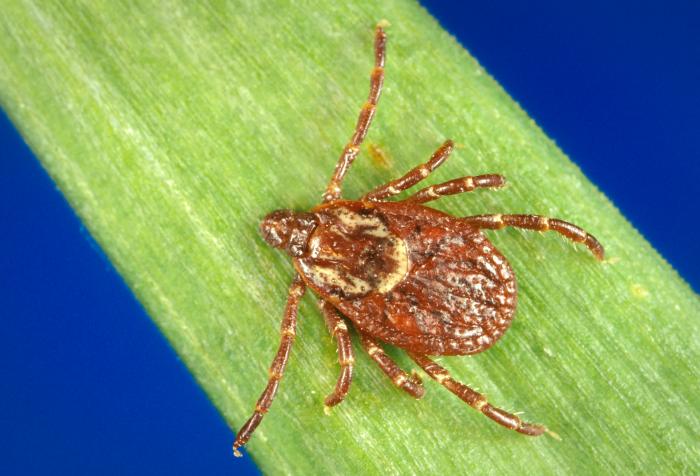
Female Dermacentor variabilis, American dog tick, from Panola Park near Atlanta, Georgia.

Content Provider(s): CDC / DVBID / Gary O. Maupin

Photo Credit: CDC / PHPPO / DMTS / James Gathany


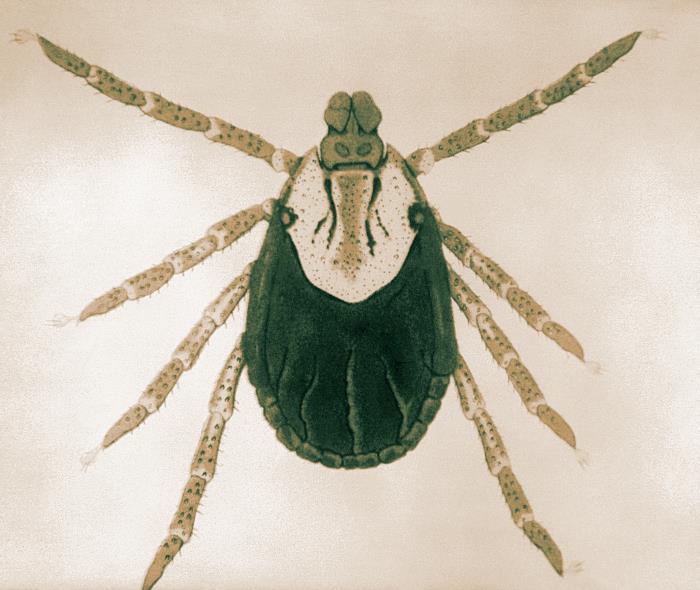
Description:

This illustration depicts a dorsal view of a female “hard”, or Ixodidae “American dog tick”, Dermacentor variabilis.

The two major vectors of Rickettsia rickettsii, the bacteria responsible for Rocky Mountain spotted fever in the United States are the American dog tick, Dermacentor variabilis, pictured here, and the Rocky Mountain wood tick D. andersoni.

Content Providers(s): CDC / Andrew J. Brooks

Creation Date: 1972


Copyright Restrictions:

None - These images are in the public domain and thus free of any copyright restrictions. As a matter of courtesy we request that the content providers be credited and notified in any public or private usage of these images.

Monday, January 31, 2005

Tick-Borne Diseases in Santa Cruz County 2003-2004

Annual Report 2003-2004, Santa Cruz County Mosquito and Vector Control District

The County had 8 reported cases of Lyme disease, and one reported case of Rocky Mountain spotted fever in 2003, and 3 reported cases of Lyme disease in 2004 from tick bites. Lyme disease continues to be the most important vector-borne disease in the State, with an average of 200-300 reported cases per year. A recent study by San Jose State University suggested that the infection rate of Ixodes pacificus ticks with Lyme disease in our County may be higher than in other parts of the state, with the number infected averaging 5-6%. This finding was notably higher than previously reported prevalence estimates, although the infection rate in this area is still relatively low compared to that of some east coast states.... Prevention of bites and recognition of symptoms by the public and physicians are the recommended methods of dealing with tick-borne disease.

Friday, June 18, 2004

Ticks and Tick-Borne Diseases in Napa County

Source: Tick-Borne Diseases, Napa County Mosquito Abatement District

Lyme disease is present in Napa County. There were three diagnosed cases in 2001.

Rocky Mountain Spotted Fever is present in Napa County. There was one case reported by the California Department of Health Services in 2000.

The tick vector for Tularemia is present in Napa County. No known diagnosed cases have been reported.


Source: Summary of Napa County Ticks, Napa County Mosquito Abatement District

Napa County has 10 confirmed species of ticks, including the following which are vectors of Lyme Disease, Q Fever, Rocky Mountain Spotted Fever, Tularemia, and Tick Paralysis to humans.

Ixodes pacificus
Western Black-legged Tick
Widespread Californian Tick. Life cycle can be completed in less than one year but usually lasts about two years. Females lay eggs in the spring on the undersides of brush and dried leaves. Eggs hatch during early summer. Nymphs and adults seek hosts (quest) from the tips of vegetation while larval ticks find hosts close to the ground. Most commonly encountered Ixodes tick in California. Adults occur year-round but are most commonly found November through May. Nymphs are most commonly found March through June but can be found year-round. Immature stages commonly found on Alligator Lizards, Fence Lizards, and ground inhabiting birds. Sometimes found on small rodents and rabbits. Large mammals are also important hosts for larvae and nymphs. Adults are common on deer and other large mammals (dogs, bears, cats, horses, humans, etc.).
Vector of Lyme Disease. Has caused tick paralysis in a dog.

Dermacentor occidentalis
Pacific Coast Tick
Common, widespread Californian tick. Adults are found year-round with peak activity in April and May. Nymphs are most common during spring and summer. Adult hosts tend to be cattle, horses, deer and humans. Rare on dogs and bears. Nymphs tend to feed on rodents and other small mammals.
Capable of transmitting many diseases. Vector of bovine anaplasmosis. Has been found naturally infected with Colorado Tick Fever virus, the Rickettsia of Q Fever and the bacterium that causes Tularemia. Known to cause tick paralysis in cattle, horses and deer. Spotted fever group Rickettsiae have been found in ticks collected from Mendocino County. Bite wounds are commonly mistaken for wounds caused by biting insects and spiders.

Dermacentor variabilis
American Dog Tick
Widespread Californian tick. Life cycle can be completed in less than one year or take longer than two years if suitable hosts are not available. Adults are present year-round while nymphs and larvae are most active late winter to summer. Adult females may take up to 13 days to complete feeding on a host and can produce as many as 6500 eggs during their lifetime. Immature ticks are capable of surviving extreme winter temperatures. Dogs are the preferred host although adults will feed on humans and many other species of large wild and domesticated mammals. Larvae and nymphs tend to feed on rodents and rabbits.
Important vector of Rocky Mountain Spotted Fever, especially in the Eastern United States. Vector of Tularemia to humans. Known to cause tick paralysis.